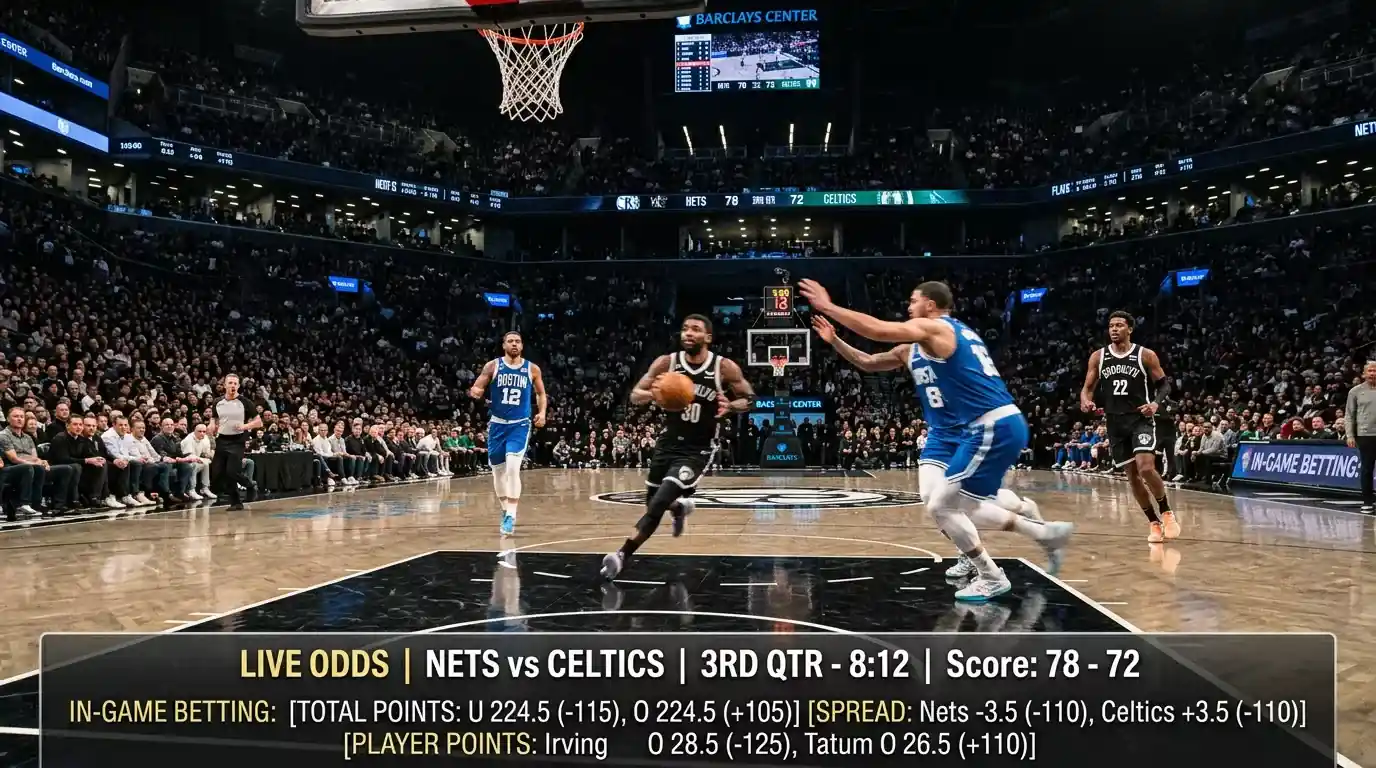
NBA Betting Guide
NBA Bets of the Day UK 2026
 Available in US
By NBA Betting Analyst — Specialised in UK-market basketball wagering

- Top NBA Betting Metrics for Tonight’s Games
- Why UK Bettors Are Turning to NBA Every Night
- The NBA Betting Boom in Britain: Numbers Worth Knowing
- Spread, Moneyline, Totals: What UK Bookmakers Actually Call Them
- Timing Your NBA Bets Around UK Kick-Off Hours
- How Accurate Are NBA Betting Predictions? The Research Behind the Numbers
- Home Court Advantage: A Quantified Edge for UK Punters
- Back-to-Back Fixtures: The Scheduling Factor Every Bettor Ignores
- Bankroll Basics: How to Size Your Daily NBA Stakes
- How CourtEdge Structures Its Daily NBA Picks
- Who Bets on NBA in the UK? A Statistical Profile
- Go Deeper: Specialist Guides for UK NBA Bettors
- Common Questions About NBA Betting in the UK
- Betting Responsibly on NBA: What UK Regulations Require
Top NBA Betting Metrics for Tonight’s Games
- NBA viewership on Sky Sports has grown 40% since 2019. The UK audience is real, young, and growing, which means bookmaker competition for your business is rising too.
- ML prediction models for NBA outcomes achieve 65–80% accuracy depending on features used, but most free tipster services don’t disclose their methodology at all.
- Home teams win 58–60% of NBA regular-season games, and that edge translates to roughly 3–5 points on the spread.
- Back-to-back fixtures create measurable fatigue effects that bookmakers consistently under-price. It is one of the few genuine scheduling edges available.
- UK bookmakers label “spread” as “handicap” — understanding the naming differences before you bet prevents costly confusion on your first slip.
Why UK Bettors Are Turning to NBA Every Night
I remember the first season I seriously started betting on NBA from the UK, staying up past midnight with a cup of tea going cold on the desk, trying to make sense of American odds formats on a British bookmaker platform, wondering why the game I’d backed at 7pm hadn’t tipped off yet. That confusion cost me money. Not because my reads were wrong, but because I hadn’t done the basic groundwork of understanding how this market actually works for someone sitting in Manchester or Bristol rather than New York or LA.
That gap. This is the gap between what NBA betting content assumes you know and what UK punters actually need, and itis exactly what this guide addresses. The market has changed dramatically since then, and the numbers back it up. Basketball has climbed seven positions to become the 13th most-engaged sport in the UK overall in 2026, and the 6th most popular among adults aged 18 to 24, driven by social media content, live-streaming, and the growing visibility of the league on Sky Sports, where NBA viewership has grown 40% since 2019.
That audience growth maps directly onto betting activity. Per industry analysis from S&P Global, 57% of UK NBA viewers are under 35, one of the youngest viewer profiles among major NBA markets globally. These are active, digitally fluent bettors, many of them comfortable with same-game parlays and player props rather than just backing a winner. The nightly NBA slate, running from roughly October to June, gives you five to fifteen games most evenings. That density creates daily betting opportunities that football’s weekend structure simply doesn’t match.
This guide covers everything you need to approach those opportunities intelligently. We’ll go through how UK bookmakers actually label NBA markets (the naming differences matter more than you’d think), what the research says about prediction accuracy, the scheduling factors your competitors consistently ignore, and how to structure your daily staking so a bad week doesn’t wipe out a good month. Whether you’re placing your first NBA bet or you’ve been at this for a few seasons, there’s a framework here that applies.
The NBA Betting Boom in Britain: Numbers Worth Knowing
The UK gambling industry doesn’t just tolerate basketball betting: it has quietly become one of the sector’s growth stories. The Gambling Commission’s annual statistics for 2024/25 recorded a gross gambling yield of £16.8 billion across the industry, up 7.3% year on year, with the online sector accounting for £7.8 billion of that, a jump of more than £900 million in a single year, as noted by Jason Davis, Data Analytics Manager at the Gambling Commission. That growth is coming from somewhere, and increasingly, it’s coming from sports markets that were barely a footnote a decade ago.
Online real-event betting specifically (the category covering NBA wagers) grew 5% year on year in the final quarter of 2024/25, reaching £596 million for that quarter alone. Across the UK, around 290 million online sports bets are placed every month. The market for UK sports betting is projected to reach £16.8 billion by 2030 at an 11.4% compound annual growth rate. That’s not niche territory anymore.
The average number of active online betting accounts in the UK sits at 13.5 million per month. That’s the competitive environment your bookmaker is operating in, which is why they’re increasingly offering NBA-specific odds boosts, enhanced props markets, and same-game parlay builders to capture a share of it.
What makes this interesting from a betting perspective is the structural shift in how the UK audience relates to basketball. The EY-Parthenon Sports Engagement Index for 2025 found basketball rising seven places in overall UK engagement, driven specifically by content creation and live events. That’s a young, digitally native audience, the same demographic making up 76% of mobile gambling users in the 18-to-24 age bracket. These bettors are more comfortable with prop markets and parlays than their predecessors, and that demand is shaping what UK bookmakers now offer for NBA.
Basketball is the second most-participated team sport in England, with more than 1.5 million people playing weekly according to Basketball England. Youth participation in the 14-to-25 bracket has grown 65% since 2018. That grassroots familiarity is turning into an adult betting audience at a rate the traditional sports betting model didn’t anticipate.
The practical implication for you as a bettor: UK bookmakers are investing in NBA coverage. That means more markets per game, deeper prop lines, and in some cases genuinely competitive odds. But it also means the lines are sharpening. What was a soft market five years ago has become a market where the big operators are pricing seriously. Understanding the mechanics before you place any money is no longer optional — it’s the baseline.

Spread, Moneyline, Totals: What UK Bookmakers Actually Call Them
The first time I loaded an NBA market on a UK bookmaker, I spent a genuinely embarrassing amount of time searching for the “spread” before realising the bet I wanted was sitting right there labelled “handicap.” That’s not a minor quirk; it’s a naming convention difference that trips up almost every UK punter coming to NBA from American content. So let me map it out properly.
Point Spread / Handicap: The market where one team is given a virtual head start or deficit to level the betting field. If Golden State are listed at -6.5, they need to win by 7 or more for that bet to land. UK bookmakers call this “handicap”. The mechanics are identical; only the label differs. You’ll see it written as “Golden State Warriors -6.5” or “Boston Celtics +6.5.”
Moneyline / Match Winner: The simplest bet: pick which team wins outright. On American sites this is “moneyline”. On UK platforms it’s typically labelled “match winner” or just appears as standard home/away odds. If you back a heavy favourite, your implied probability is high but the return is modest. Underdog moneylines carry the opposite dynamic.
Totals / Over-Under: You’re betting on the combined points scored in the game, not the result. The bookmaker sets a line, say 224.5, and you pick whether the final total will be over or under that number. UK bookmakers tend to label this exactly: “Over 224.5 / Under 224.5.” This one’s consistent across US and UK platforms.
Player Props / Specials: Wagers on individual player statistical outputs: points, rebounds, assists, threes made, and so on. In the US these are “prop bets.” UK bookmakers list them as “player specials” or simply under the player’s name in the match page. The market depth varies significantly between operators. Some offer props for five or six players per game, others go much deeper.
Bet Builder / Same-Game Parlay: A tool that lets you combine multiple selections from the same game into a single bet. UK bookmakers call this “bet builder”, the American equivalent being “same-game parlay” or SGP. Because all legs come from the same game, correlations between selections are a key consideration, which most punters underestimate.
The odds format itself is another source of friction. US sports content quotes moneyline odds in American format: positive (+150) for underdogs, negative (-180) for favourites. UK bookmakers default to decimal odds or fractional odds depending on the platform, though most now let you toggle between formats. Decimal odds are cleaner for calculating implied probability: if a team is priced at 1.55 in decimal, your implied probability is 1 divided by 1.55, which gives you roughly 64.5%. That single calculation is the foundation of every value assessment you’ll ever make.
| Format | Example odds | Implied probability | Profit on £10 stake |
|---|---|---|---|
| Decimal (UK default) | 1.80 | 55.6% | £8.00 |
| Fractional (UK traditional) | 4/5 | 55.6% | £8.00 |
| American (US format) | -125 | 55.6% | £8.00 |
All three rows represent the same price. The format changes; the underlying probability does not.
One more terminology point worth flagging: UK betting terminology also includes “accumulator” where Americans say “parlay.” A regular NBA accumulator combines selections from different games; a bet builder or same-game parlay combines selections within a single game. The distinction matters because correlated selections are handled differently by bookmakers in each case.
Timing Your NBA Bets Around UK Kick-Off Hours
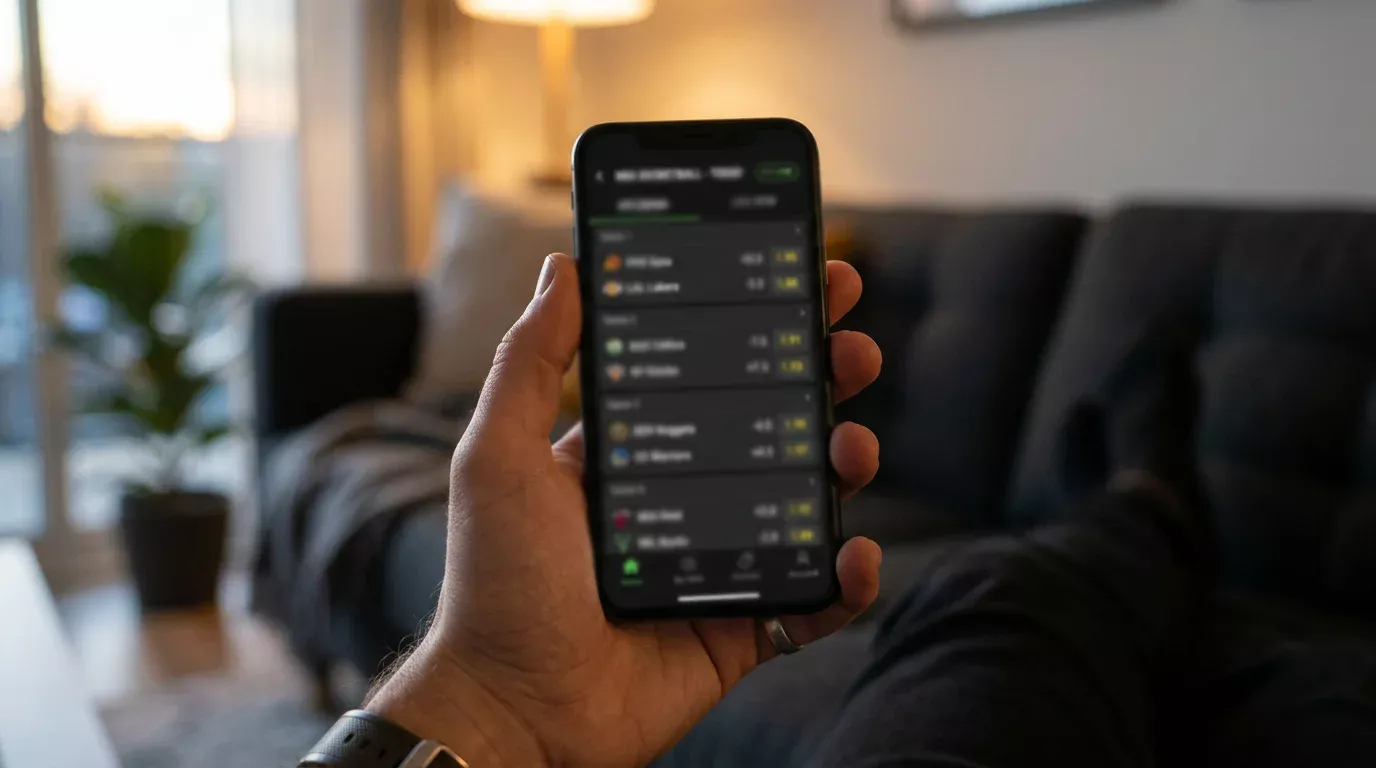
Here’s a fact that almost no NBA betting content aimed at UK audiences addresses: the games tip off between 1:00am and 4:00am London time. That’s not a minor inconvenience. It’s a structural feature of NBA betting from the UK that shapes every part of how you engage with the market.
Key timing windows for UK NBA bettors in 2026:
Early games on the East Coast tip off around 1:00am to 1:30am GMT/BST. Late West Coast games (Pacific time, minus 8 hours from GMT) start around 3:30am — 4:00am. During British Summer Time (late March to late October), subtract one hour from those figures, giving 12:00am and 2:30am respectively. Pre-game injury reports are typically released around 6:00pm — 7:00pm Eastern, which is 11:00pm — midnight UK time. That window is when you want to be finalising any pre-game positions.
The practical implication is that most UK punters are betting on NBA before the game rather than in-play. You’re placing a position at 10pm or 11pm UK time based on information available then, and the outcome lands while you’re asleep. That’s not necessarily a disadvantage. In fact, placing bets before sharp US money moves the line can work in your favour on certain markets. But it does mean your pre-game analysis needs to be solid, because you’re rarely in a position to react to the game as it unfolds.
Optimal bet placement window
10:00pm — 11:30pm UK time: injury reports confirmed, lines stable or showing late movement from sharp US money. This is when your decision should be finalised.
Watch for late scratches
The NBA’s official injury report has a final update around 90 minutes before tip-off. For a 1:00am UK game, that means an 11:30pm update. A star player listed as “questionable” at that point can become “out” before midnight — and lines move fast when that happens.
Live betting challenge
Betting in-play on NBA from the UK is genuinely difficult. By the time the Q1 line shifts attractively, it’s past midnight. Most successful UK NBA punters focus their strategy on pre-game markets and treat live betting as an occasional supplement rather than a primary approach.
The timezone factor also affects how you research your bets. American sports media dominates NBA content. Podcasts, beat reporter coverage, injury news all comes out in US Eastern or Pacific time, which means the freshest information often drops between 6pm and midnight UK time. Building a quick daily routine around that window — checking injury reports at 11pm, scanning line movement before bed — is a habit that pays off over a season.
How Accurate Are NBA Betting Predictions? The Research Behind the Numbers
Every tipster site you find will claim impressive hit rates. Most won’t show you their methodology. So let me share what the actual research says, because the gap between marketed accuracy and empirically verified accuracy in NBA predictions is significant — and understanding that gap is what separates a punter who manages their expectations from one who ends up chasing losses.
A systematic review of 34 machine learning studies on NBA game prediction published in 2025 in PLoS ONE found that predictive models achieve accuracy in the range of 65–80%, depending on the number and quality of features used. That range, ranging from 20 to 60 statistical inputs, — represents a substantial difference in model complexity. The researchers behind that review describe NBA outcome prediction as a critically important area for both sports science and betting decision-making, a framing that sounds academic but carries a practical implication: even the best models are wrong roughly one time in four.
Commercial AI prediction tools have their own published numbers. OddsTrader’s five-star picks carry an average verified accuracy of 73.43%, with four-star picks running at 60%. Oddschecker’s Positive EV engine runs 100 million projections per week and tracks 125 million odds changes daily — not because they’re certain about outcomes, but because value exists in pricing discrepancies at scale rather than in picking individual winners with high confidence.
The important distinction here is between “accuracy” as a raw win rate and “accuracy” relative to the closing line. A tipster who hits 54% of spread bets at average odds of 1.90 (10/11 in fractional) is, in theory, marginally profitable — but only barely, and only over a very large sample. A tipster hitting 51% at average odds of 1.95 might outperform them. The number that matters is return on investment, tracked over a minimum of several hundred bets, not a single week’s strike rate.
Understanding the numbers: what 65% accuracy actually means in practice
Suppose a model predicts 10 NBA games per night at 65% accuracy.
Over a seven-day week, that’s 70 predictions. You’d expect roughly 45 correct and 25 incorrect.
At flat stakes of £10 per bet and average decimal odds of 1.90: each winning bet returns £9 profit. 45 wins generate £405 profit; 25 losses cost £250. Net profit for the week: £155 — but the range around that figure is wide. A below-average week might see 38 correct from 70, which leaves only £92 net — barely ahead of break-even.
The lesson: 65% accuracy is legitimately good, but it requires volume and flat staking to realise consistently. It does not mean seven guaranteed profitable days in a row.
The data available for NBA predictions is, notably, excellent. Key inputs are freely accessible: team offensive and defensive ratings, pace, net rating, home and away splits, rest days, back-to-back flags, and injury reports. Bryant University research on NBA outcome prediction confirms this directly: the data required is publicly available, which means the barrier is methodology, not access. That’s good news if you’re building your own approach, and a useful filter when evaluating external tipsters. If they can’t tell you what inputs they use, that’s telling.
For a deeper dive into how to apply these predictive frameworks to finding NBA value bets systematically, our dedicated guide walks through the EV calculation step by step.

Home Court Advantage: A Quantified Edge for UK Punters
The 3-to-5 point home court advantage in the NBA is one of the most-cited numbers in basketball betting. It is also one of the most misunderstood. Yes, home teams win 58–60% of regular-season games. Yes, that translates to roughly 3–5 points on the spread. But the number isn’t static, it isn’t uniform across teams, and bookmakers have already priced most of it in.
The interesting edge isn’t in backing home teams blindly, but in identifying which home courts are genuinely more advantageous than the market reflects. Historical against-the-spread data shows substantial variance by franchise. OKC Thunder, for example, covered the spread in 64% of home games over a 2.5-season stretch from 2022 to 2025, the best rate in the league. That kind of sustained outperformance at home reflects a combination of crowd noise, altitude, and the specific style matchups that venue conditions favour.
Research comparing home court advantage across major professional sports finds that the NBA edge is more valuable than in several other leagues. The combination of crowd noise effects on referee decision-making, the familiarity of floor dimensions and lighting, and shorter travel schedules for home teams all compound in ways that go beyond simple rest differentials.
The practical application for UK bettors is to treat home court as one input among several rather than a standalone reason to bet. When a strong home team faces a visitor on a back-to-back schedule — which amplifies the road disadvantage — the combined effect can create genuine pricing gaps. When a home team with a strong crowd environment is resting two key starters, the advantage may be neutralised entirely. Context determines whether the 3–5 point general figure applies to a specific game. Our back-to-back scheduling guide explores how rest differentials compound with home court to create the clearest edges in the regular season.
Back-to-Back Fixtures: The Scheduling Factor Every Bettor Ignores
In nine years of analysing NBA markets, I’d argue that back-to-back scheduling is the single most consistently under-exploited variable in UK NBA betting. It’s hiding in plain sight: the schedule is publicly available, the effect is statistically robust, and the vast majority of recreational bettors simply don’t check it before placing a bet.
A back-to-back (B2B) in NBA terminology is when a team plays on two consecutive calendar days. Each team plays roughly 15–18 B2B sets per regular season. The research is clear on what this does to performance: rest disadvantage shows up in point differentials, spread coverage rates, and particularly in the performance of key contributors logging heavy minutes. Teams playing the second night of a B2B see measurable drops in offensive efficiency and defensive intensity — the effects are strongest when the second game involves travel, especially cross-timezone travel.
What makes B2B betting actionable for UK punters: UK bookmakers do not always explicitly flag B2B situations in their NBA market displays. You need to check the schedule yourself — the NBA’s official schedule page and basketball-reference.com both show this clearly. When you find a game where the road team is on the second night of a B2B and the home team is rested, you have found a structural pricing variable that many punters around you haven’t considered. That’s the definition of a potential edge.
The B2B angle also interacts with props markets. A star player’s minutes and shooting efficiency often dip significantly on second nights, but player prop lines don’t always reflect the full adjustment. This is the territory our dedicated back-to-back betting guide maps out with specific frameworks and historical data patterns.
Back-to-backs, travel and rest differentials move the true line by points, not decimals — and they are sitting in a public schedule that most punters never open. Set the situation, add your own read on the two teams, and the calculator tells you what the handicap should be and whether the posted number leaves anything on the table.
How it works. The projected handicap is your neutral-floor rating gap, plus the home court value, plus the rest differential between the two sides, plus a travel adjustment applied to the visitor. A second night of a back-to-back is treated as roughly two points of lost performance, extra rest as a small positive, and cross-country travel as a further deduction. Margins are treated as normally distributed with a standard deviation near 11.5 points, which converts a points edge into a cover probability. More in the guides to back-to-back betting and value bets.
Estimates only. Check the final injury report, which lands about 90 minutes before tip-off — roughly 11:30pm UK time for a 1am game. A rested team resting starters is not a rested team. 18+ — please gamble responsibly. Free, confidential support at BeGambleAware.
Bankroll Basics: How to Size Your Daily NBA Stakes
This is the section that the most confident punters skip and the most experienced ones read twice. Staking discipline isn't glamorous, but it's the mechanism that determines whether a winning approach — even one with a genuine edge — actually generates a positive return over a season.
The NBA season runs from October to June: roughly 1,230 regular-season games across eight months, followed by the playoffs. If you're betting daily, you're making a very large number of decisions over a sustained period. Variance compounds across that volume. A flat-staking approach, where you bet the same pound amount on every selection, regardless of perceived confidence — is not the conservative option. It's the mathematically sound one for most recreational bettors, because it limits the damage of overconfidence on individual picks.
Pre-bet checklist: before placing any NBA wager tonight
- Is the injury report confirmed for both teams? (final update: ~90 min before tip-off)
- Are either of the teams on the second night of a back-to-back?
- What is your stake as a percentage of your total NBA bankroll? (target: 1--3% per bet)
- What odds format is your bookmaker displaying, and have you confirmed the implied probability?
- Have you checked for late line movement since you first assessed this game?
- Does the bet still make sense given any news that's broken in the last hour?
The unit system is an alternative to pure flat staking that many experienced UK NBA bettors prefer. You define one "unit" as a fixed percentage of your bankroll — typically 1% to 2% — and then size bets at one, two, or three units based on your assessed confidence. The discipline requirement is keeping your three-unit bets genuinely rare: if everything is three units, the system collapses back into undifferentiated flat staking with more mental overhead.
For a complete treatment of staking models including Kelly Criterion and how UK bookmaker bonuses interact with your bankroll calculations, see our guide on NBA bankroll management for UK bettors.

How CourtEdge Structures Its Daily NBA Picks
Transparency about methodology is something I wish more NBA tipster sites offered. So here's exactly how picks get evaluated before they appear on this site.
Every game on the night's NBA slate goes through an initial screen before any analysis begins. That screen checks: rest differential between the two teams, B2B flags, injury report status, and home/away splits over the past 30 days. Games that fail the screen — where the situational context is too noisy or no clear edge exists — simply don't become picks. Selecting fewer games per night but with stronger conviction produces better results than forcing a pick on every game to fill space.
Spread / Handicap
Primary consideration: line value relative to our projected margin. We look for at least 2--3 points of perceived edge before recommending a spread bet. Minimum confidence threshold before publication.
Player Props
Driven by matchup data and minutes projection. If a key rotation player is doubtful, we reassess any props touching their on-court collaborators. Lines that haven't adjusted to injury news within 60 minutes of confirmation are the most interesting.
Totals (Over/Under)
Pace of play, offensive rating, and B2B fatigue effects all feed into totals assessment. We prefer totals markets when the situational factors are clearest and the spread offers no obvious edge.
For context, research on AI-powered prediction tools puts five-star rated picks at 73.43% average accuracy. That's a reference point, not a promise. The goal is to identify games where the market price doesn't fully reflect available information — which is a distinct task from simply predicting the winner at a high rate. Even a selection that wins 58% of the time generates profit if the implied probability in the odds was below 58%.
Who Bets on NBA in the UK? A Statistical Profile
Knowing your market — which in this context means knowing who else is placing bets alongside you — shapes how you think about where edges exist and where the public money is moving.
The UK's sports betting demographic skews heavily male: 15% of men engage in sports betting compared to just 4% of women, per Gambling Commission data. Overall, around 10% of UK adults bet on sport online. The mobile penetration in the 18-to-24 age bracket is 76%. These are bettors placing wagers from their phones, often in the hour before a game, rather than at a desktop with time to research.
The S&P Global Kagan data on UK NBA viewership is striking: 57% of the UK audience is under 35. Compare that to basketball's 6th-place ranking in Gen Z sports engagement in the 2025 EY-Parthenon index, a sport that was barely registering a decade ago is now a primary viewing and betting interest for a large portion of the young UK sports audience. As EY-Parthenon noted in their index, this rise "is driven by content creation and attendance at live events", an organic growth pattern rather than a forced TV rights deal.
The practical implication of this demographic profile: the recreational NBA bettor in the UK is typically young, mobile-first, and drawn to the entertainment aspects of the sport rather than the deep statistical analysis. That creates a market where well-researched bets have more room to find value — not because the bookmakers are soft (they aren't) but because the recreational public money often follows stars, narratives, and social media sentiment rather than scheduling and situational analysis.
Understanding that you're in a market partly shaped by less-informed money doesn't make winning easy, but it does point to where the work is worth doing: scheduling factors, injury report timing, and line-movement analysis rather than simply watching the same games as everyone else and forming the same impressions.
Go Deeper: Specialist Guides for UK NBA Bettors
This guide gives you the framework. The five specialist resources below give you the depth on each component — the kind of detail that's worth reading before you commit real money to any one market type.
If you're betting on the spread, which UK bookmakers call "handicap",the mechanics of reading lines, understanding ATS records, and shopping for the best price across platforms are all covered in detail in our guide to NBA spread betting tips for UK punters. If you're building prop-heavy strategies or using bet builder tools, our NBA player props guide covers matchup methodology, injury report impact, and the specific correlations that make or break same-game parlays.
For anyone wanting to move beyond picking and into genuine expected value thinking, the NBA value betting guide walks through implied probability conversion, EV calculation, and the practical steps to spot mispriced lines without needing commercial tools. The structural edges that come from the schedule, including back-to-back fatigue, rest advantages, and road trip clusters,are laid out systematically in our NBA back-to-back betting guide.
And underpinning all of it: staking. The best analysis in the world underperforms if your stake sizing is inconsistent. Our NBA bankroll management guide covers flat staking, unit systems, and how to structure your bankroll across a full season of daily NBA action.
With the framework and the specialist reading in place, the questions below address the practical queries most UK punters bring to NBA betting for the first time — and a few that experienced punters still get wrong.
Common Questions About NBA Betting in the UK
How does NBA spread betting work for UK bettors?
NBA spread betting, labelled "handicap" on UK platforms, means you're betting on the margin of victory rather than the outright winner. The bookmaker sets a line, say -6.5 for the favourite. If you back them, they need to win by 7 or more for your bet to land. If you back the underdog at +6.5, they just need to either win outright or lose by 6 or fewer. The half-point (.5) is deliberate. It eliminates the possibility of a push (dead heat), which would occur if the margin landed exactly on a whole number. UK bookmakers use the same mechanics as their US counterparts; only the labelling differs.
What time do NBA games start in the UK?
Most NBA games tip off between 1:00am and 4:00am UK time. Early Eastern Conference games start around 1:00am--1:30am GMT (midnight--12:30am BST during summer). West Coast games start later, typically 3:00am--4:00am GMT. This means almost all pre-game betting happens in the evening before you sleep, and the outcome lands while you're asleep. The official final injury report drops roughly 90 minutes before tip-off. For a 1:00am game, that's approximately 11:30pm UK time. That's your cut-off for any last-minute line assessment.
Which UK bookmakers offer the best NBA markets?
Several UK-licensed operators offer NBA markets — bet365, Sky Bet, Paddy Power, Betfair, and William Hill all cover the major daily markets including handicap, match winner, and totals. The depth of player props varies more significantly between operators than the headline markets. For same-game parlay (bet builder) availability, it's worth checking which operators offer the specific player and team combinations you want before finalising your account choices. I'd strongly recommend against recommending a specific operator ranking here — market depth and pricing shift seasonally, and the best comparison is always a direct check on the specific game you're analysing rather than a general ranking.
What is a "value bet" in NBA betting and how do I find one?
A value bet exists when your assessed probability for an outcome is higher than the probability implied by the bookmaker's odds. If you calculate a team has a 55% chance of covering the spread, but the bookmaker's odds imply only a 50% chance (i.e., the price is higher than it should be), you have found a value bet. Finding them requires converting odds to implied probability — divide 1 by the decimal odds — and then comparing that figure against your own assessment. The challenge is building a reliable probability estimate; that requires data inputs beyond just gut feel, including recent form, rest days, injury status, and head-to-head matchup history at minimum.
How accurate are NBA betting predictions and tipster services?
Research on machine learning NBA prediction models shows accuracy in the range of 65--80% depending on model complexity. Commercial tools that publish verified records tend to show similar figures — around 73% for top-rated selections in tools where transparency is highest. However, raw accuracy isn't the right metric. What matters is whether the picks beat the closing line, i.e. whether the odds obtained were better than the final market price. A tipster hitting 60% of spread bets at average odds of 1.90 is roughly break-even; a tipster hitting 55% at average odds of 2.10 might be significantly profitable. Always ask for ROI figures and sample size before acting on any external service's record.
What is a same-game parlay (bet builder) for NBA?
A same-game parlay (called "bet builder" on UK platforms) combines multiple selections from a single game into one bet. For example: Team A to win, Player X to score 25+ points, and the game total to go over 218.5 — all from the same game. Because all legs come from the same event, there are correlations between them. A player scoring 25+ points is more likely in a high-scoring game, so pairing that with the over creates a positively correlated bet. Bookmakers adjust odds to account for correlations, but they don't always do so accurately, which is where opportunity exists, and also where the traps are most common.
How much should I stake on daily NBA bets?
A common starting framework for daily NBA betting is 1--3% of your total NBA bankroll per bet. At 1% per bet, you'd need to lose 50 consecutive bets to exhaust half your bankroll, giving you time to identify and correct problems in your approach before the damage is irreversible. The specific percentage depends on your assessed edge: smaller stakes are appropriate when edge is uncertain, larger (still within reason) when your analysis is strongest. Flat staking at a fixed pound amount is simpler than unit-based systems and reduces the temptation to size up on emotional conviction rather than analytical conviction.
Betting Responsibly on NBA: What UK Regulations Require
The UK's regulatory framework for gambling is among the most comprehensive in the world. Every operator serving UK customers must hold a Gambling Commission licence. As of 2024/25, there are 5,825 licensed betting offices in the country, down for the eleventh consecutive year as activity migrates online. The Commission's oversight extends beyond licensing: operators are required to provide deposit limit tools, reality checks (time-based reminders of session duration), and access to self-exclusion via GamStop, a national scheme that restricts your account across all UKGC-licensed operators simultaneously.
Tools available on all UK-licensed platforms: Deposit limits (daily, weekly, monthly); loss limits; time limits and reality check reminders; temporary self-exclusion (cooling-off periods); permanent self-exclusion via GamStop; links to BeGambleAware for independent support. These are not optional features — they are regulatory requirements. If a platform doesn't offer them clearly, that's a red flag about its licensing status.
NBA betting — precisely because games run late and the daily schedule is dense — creates specific responsible gambling considerations. The combination of late-night engagement, the temptation to recoup same-day losses before bed, and the sheer volume of daily games can accelerate the kind of behaviour patterns that shift gambling from entertainment into problem territory. None of that is unique to NBA, but the structure of the sport makes awareness worthwhile. If you notice your bet sizing increasing after losses, if you're placing bets you hadn't planned, or if the amount of time you spend on betting is affecting other areas of your life, the tools above are there to help — and organisations like BeGambleAware offer free, independent support.
Created by the ”nba Bets of the day” editorial team.